Newtec Power Equipment Co., Ltd.
English


Views: 0 Author: Site Editor Publish Time: 2026-10-27 Origin: Site
Equipping your vessel requires high stakes and careful planning. You cannot afford tripped breakers during a sweltering night at anchor. You also cannot risk premature engine wear from chronic under-loading. Marine power demands a precise balance between output capability and environmental resilience.
Many boat owners struggle to match their electrical load profile against tight spatial constraints. This often leads to mismatched onboard systems. An under-sized unit sacrifices essential comforts. Conversely, over-sizing causes cylinder glazing and reduces engine lifespan. Navigating these technical details remains crucial for safe, uninterrupted cruising.
This guide provides an objective, manufacturer-agnostic framework. It helps you evaluate and size the right equipment correctly. You will learn how to calculate precise power requirements. We also cover selecting optimal engine speeds and managing installation realities. Read on to master the complexities of onboard power generation.
Sizing is critical: Calculate total surge and running watts; aim for a consistent 70–80% load to ensure longevity.
Match your main engines: Default to the same fuel type (diesel or gas) as your propulsion system for safety and fuel management.
RPM dictates lifespan and comfort: 1500/1800 RPM units offer quieter, long-term durability, while 3000/3600 RPM units save space and weight for smaller vessels.
Installation dictates success: Proper exhaust routing, sound shielding, and single-side service accessibility are just as important as the brand you choose.
Boat owners sometimes try cutting corners. They attempt to marinize RV or portable power units. This land versus sea distinction carries immense risk. Land-based units lack the engineering required for marine environments. They rely on air cooling, which quickly overheats a cramped vessel engine room. Using non-marine equipment onboard invites catastrophic failures.
Regulatory and safety compliance remains paramount. The United States Coast Guard (USCG) and the American Boat and Yacht Council (ABYC) enforce strict standards. They mandate ignition protection. Bilges naturally collect explosive gases. Gasoline vapors sink and pool low in the hull. Standard alternators and relays spark during normal operation. A properly rated Marine Generator seals these electrical components. This prevents explosive vapor ignition entirely.
Harsh environment engineering defines proper marine equipment. Saltwater induces aggressive corrosion. Manufacturers counter this using specialized epoxy coatings and marine-grade alloys. Furthermore, marine systems utilize water-cooled exhausts. They inject raw cooling water directly into the exhaust stream. This drastically lowers exhaust temperatures before gases exit the hull. It keeps the engine room cool and prevents fiberglass delamination.
Determining your electrical needs requires basic math and precise observation. You cannot guess your load profile. The sizing formula hinges on distinguishing running wattage from starting surge wattage.
List every alternating current (AC) appliance onboard.
Find the running wattage on the manufacturer data plate.
Identify the starting surge wattage for motor-driven appliances.
Add the highest single surge wattage to your total running wattage.
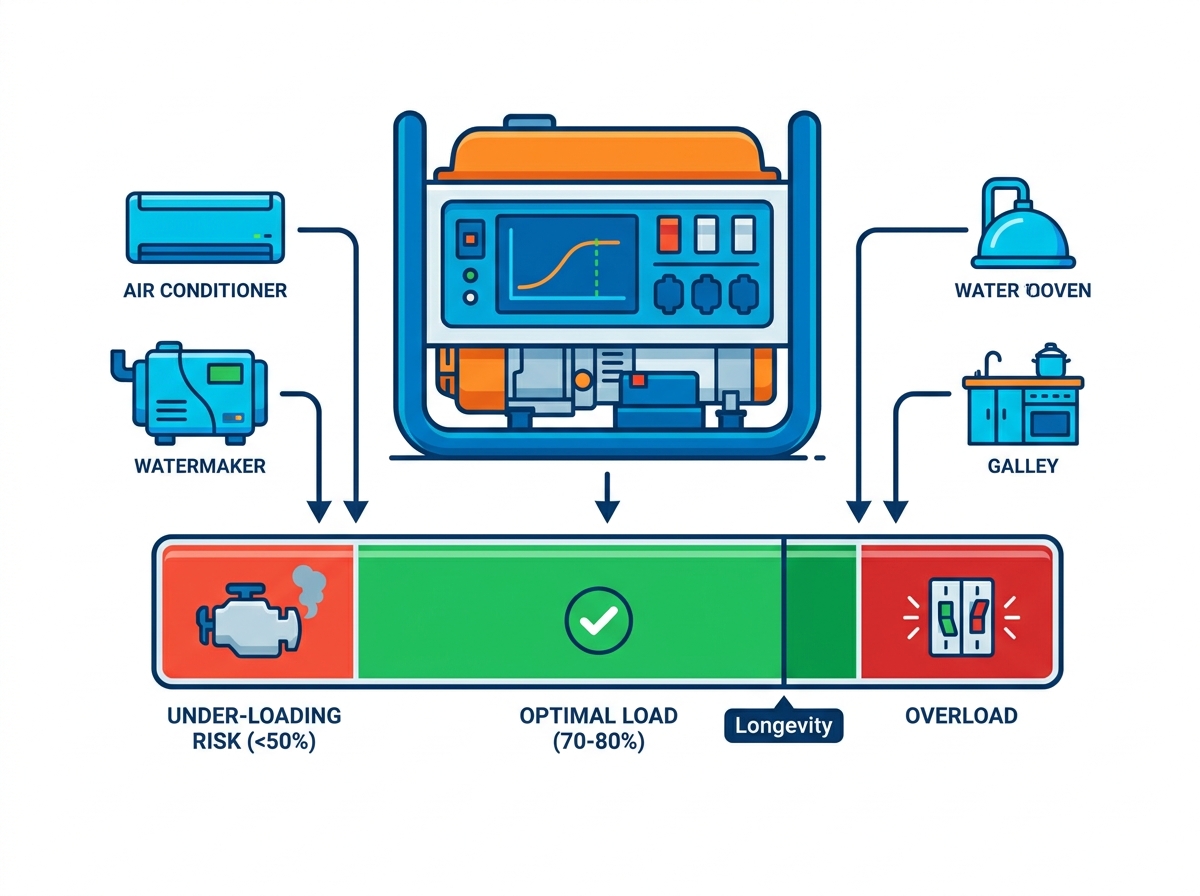
You must factor in high-draw culprits. Air conditioning compressors demand massive starting currents. Watermakers, electric galley stoves, and gyro stabilizers also draw heavy sustained loads. If you ignore these surge spikes, your breaker will trip the moment a compressor cycles on. You must size the unit to handle the peak momentary draw comfortably.
However, you must avoid the under-loading trap. Buying excess capacity seems logical, but it destroys diesel engines. Operating below operating temperature causes incomplete combustion. Unburnt fuel coats the cylinder walls in a process called cylinder glazing. Glazing smooths out the honing marks inside the cylinder. This leads to heavy oil consumption, carbon buildup, and severe loss of compression.
Industry experts recommend the 80/20 rule. Calculate your typical at-anchor baseline load. This usually involves running the air conditioning, refrigeration, and a battery charger. Size the unit so this baseline load keeps it running between 70% and 80% capacity. This ensures optimal combustion temperatures and prolongs engine life.
Your propulsion system dictates your secondary power fuel type. Diesel represents the gold standard for vessels over 30 feet. It offers significantly lower fuel consumption. Diesel engines enjoy a longer operational lifespan. They also eliminate the risk of explosive vapors accumulating below decks.
Conversely, gas units are necessary for gasoline-powered outboard or inboard vessels. Installing a diesel unit on a gas boat requires a separate fuel tank and dual-fuel management. This wastes space and complicates maintenance. However, gas units require stricter ventilation standards. You must run bilge blowers before starting them to clear potential vapors.
Engine speed profoundly impacts onboard comfort and equipment longevity. Low-speed engines run at 1500 RPM (50Hz) or 1800 RPM (60Hz). These units are physically larger and heavier. They operate exceptionally quietly. Their slow rotational mass is engineered for continuous, heavy-duty use. Liveaboards heavily favor them.
High-speed engines run at 3000 RPM (50Hz) or 3600 RPM (60Hz). They provide a compact footprint and lighter weight. This makes them ideal for smaller express cruisers. However, they produce a higher noise pitch. They experience faster internal wear over thousands of hours. Choose high-speed units for infrequent weekend use.
Engine Speed and Fuel Type Comparison
Specification | Low-Speed Diesel (1800 RPM) | High-Speed Gas (3600 RPM) |
|---|---|---|
Lifespan | 10,000+ hours (with maintenance) | 2,000 - 4,000 hours |
Noise Profile | Low, steady hum. Highly insulated. | Higher pitch. Noticeable vibration. |
Size & Weight | Heavy block, requires large footprint. | Compact, suitable for tight bilges. |
Ideal Vessel | Yachts, trawlers, long-range cruisers. | Center consoles, weekend express cruisers. |
Finding the right Marine Generator requires analyzing your physical vessel space. Spatial constraints dictate your options immediately. You must measure the engine room footprint accurately. Include overhead clearance for servicing components. On sailboats and small cruisers, weight distribution is vital. Placing 400 pounds off-center ruins your center of gravity. It negatively impacts sailing performance and handling.
Noise and vibration isolation determine your sleep quality at anchor. Evaluate factory sound shields carefully. High-quality enclosures utilize dense acoustic foam lining. They drop ambient noise by 10 to 15 decibels. Look for multi-point vibration isolation mounts. Dual-stage mounts decouple the engine from the enclosure, and the enclosure from the hull. This prevents low-frequency humming from transferring through the fiberglass.
Cooling system architecture directly impacts durability. Raw water cooling pulls outside water directly through the engine block. Saltwater degrades internal cast iron rapidly. Closed freshwater cooling utilizes a heat exchanger. Antifreeze circulates through the block. Raw water only touches the replaceable heat exchanger core. For saltwater environments, closed freshwater cooling is absolutely mandatory.
Serviceability realities are frequently overlooked during purchasing. Emphasize the requirement for "single-side serviceability". You must access daily maintenance points easily. Ensure the raw water pump, impeller, oil filter, and fuel filter face outward. If they face the hull bulkhead, you cannot service them. You would have to hoist the entire unit out of the bilge just to change a rubber impeller.
Proper installation separates reliable systems from catastrophic failures. Exhaust system pitfalls rank highest among installation errors. Water intrusion, known as hydro-lock, destroys internal engine components instantly. This occurs when poorly designed exhaust runs allow cooling water to siphon backward into the cylinders. You must install vented anti-siphon loops above the waterline. Ensure the exhaust hose maintains a continuous downward slope to the transom.
Through-hull fittings demand careful attention. You cannot share water pickups between different systems. A dedicated seacock is required.
Install heavy-duty bronze or Marelon seacocks.
Include an easily accessible sea strainer.
Ensure the strainer basket catches seagrass and marine debris.
Mount the strainer above the waterline for safe cleaning.
Electrical integration introduces hidden retrofitting costs. Upgrading power systems is rarely plug-and-play. You must upgrade your AC distribution panel to handle the new input. You need a marine-grade transfer switch. This ensures shore power and ship power never collide. Integrating marine inverters requires complex programming. The inverter must know when to supplement power and when to charge the battery bank smoothly.
Brand prestige matters less than dealer availability. A robust dealer and parts network in your cruising grounds is vital. Minor feature differences mean nothing if a proprietary circuit board fries in the Bahamas. You need local technicians who carry specific replacement parts. Choose a brand dominant in the regions you plan to navigate.
Warranty benchmarks require close reading. Evaluate commercial versus recreational warranty structures. Some warranties promise five years of coverage but only cover parts after year two. Understand labor and travel coverage. Many manufacturers refuse to pay travel time for technicians. If you anchor far from a major port, you will pay hefty hourly transit fees out of pocket.
Compile a load-calculation sheet before reaching out to vendors. Measure your engine room dimensions meticulously. Take photographs of your current electrical panel and battery banks. Contact a certified marine technician or regional distributor. Provide them your load sheet and measurements. This proactive step guarantees you receive accurate, actionable quotes.
The best system balances your exact electrical load against the physical realities of your engine room. You must prioritize proper sizing over maximum available output. Under-loading damages diesel engines just as quickly as overheating them.
Avoid purely price-based decisions. The initial purchase price represents a fraction of the total investment. Installation quality, exhaust routing, and maintenance accessibility dictate your long-term return on investment. A cheap unit buried in an inaccessible bilge will cost thousands in labor fees later.
Take action today. Compile your onboard appliance list and calculate your surge wattage. Download a standard sizing calculation sheet. Then, contact a certified marine electrical specialist to review your vessel's schematic before finalizing your purchase.
A: Yes, you can run it while underway. However, you must ensure the raw water pickup features a forward-facing scoop strainer. This prevents the vessel's speed from creating a vacuum that starves the cooling system. Always consult manufacturer guidelines, as rough seas can temporarily expose the intake and cause overheating.
A: An 1800 RPM diesel unit routinely exceeds 10,000 hours with meticulous maintenance. Conversely, a 3600 RPM gasoline unit typically requires replacement or major overhaul between 2,000 and 4,000 hours. Lifespan relies heavily on frequent oil changes and avoiding chronic under-loading.
A: It depends on your air conditioning usage. Solar and lithium handle refrigeration, lighting, and brief microwave use silently. However, running multiple air conditioners overnight quickly depletes batteries. Generators remain superior for sustained, high-surge AC loads over extended anchorages.
A: Most manufacturers recommend changing the oil and filter every 100 to 200 hours. You should inspect and replace the raw water impeller annually. Zinc anodes inside the heat exchanger require checking every 90 days to prevent internal saltwater corrosion.