Newtec Power Equipment Co., Ltd.
English


Views: 0 Author: Site Editor Publish Time: 2026-10-22 Origin: Site
Small boats pack big adventures. Space, however, remains at an absolute premium. Equipping a compact vessel for extended trips demands careful planning. Scaling onboard power often introduces strict weight, space, and safety constraints. You must balance comfort against vessel performance carefully.
Standard auxiliary power works well for quick day trips. Basic battery banks and engine alternators handle minimal loads perfectly. Extended offshore excursions quickly drain these simple setups. You need a dedicated Marine Generator to keep critical systems running securely overnight. Relying solely on propulsion batteries for heavy house loads presents a massive liability offshore.
This guide provides a realistic, compliance-focused framework for upgrading your boat. We will explore high-draw applications and match them to correct power specifications. You will learn to balance physical footprints, fuel types, and strict safety requirements. Proper planning ensures reliable onboard power without compromising your safety on the water.
Application-Driven Sizing: Selecting a marine generator depends strictly on continuous wattage requirements for critical systems (HVAC, navigation, refrigeration), not just peak output.
Compliance is Non-Negotiable: Marine-grade generators must meet ABYC standards to mitigate carbon monoxide (CO) risks and saltwater corrosion—standard portable generators present severe safety liabilities.
Weight vs. Output: In small vessels, the physical footprint and weight distribution of a generator directly impact vessel trim and fuel efficiency.
Hybrid Realities: Many modern small boats successfully pair smaller marine generators with lithium battery banks to optimize fuel consumption and minimize running noise.
Understanding your specific power consumers prevents costly sizing mistakes. We must analyze what actually drains your batteries during a typical trip. Certain systems demand far more energy than standard 12-volt DC banks can deliver.
Air conditioning remains the primary reason boaters upgrade their power systems. We measure startup surges using Locked Rotor Amps (LRA). We evaluate continuous operation using Running Load Amps (RLA). Marine AC units demand massive electrical spikes initially. The compressor requires heavy energy just to turn over. Battery banks alone usually fail during this critical startup phase. Even if they start the compressor, they struggle to sustain the continuous draw. An overnight trip in hot weather demands eight uninterrupted hours of cooling. A reliable Marine Generator absorbs these intense LRA spikes effortlessly. It then provides steady RLA power all night.
Modern sub-35-foot vessels often feature excellent galley conveniences. You might use water makers, induction cooktops, or continuous refrigeration systems. These devices require steady, uninterrupted AC power. Reverse osmosis water makers utilize high-pressure pumps. These pumps run for hours to fill your freshwater tanks. Induction cooktops draw tremendous wattage instantly when activated. A single burner easily pulls 1500 watts. Continuous refrigeration must cycle on and off constantly to prevent food spoilage. You cannot afford a power loss here.
Offshore environments demand absolute redundancy. Advanced navigation and communication systems rely on stable power continuously. Offshore radar sweeps the horizon without pause. Autopilot systems make thousands of micro-adjustments hourly. These drive motors pull heavy sustained currents. Satellite communication systems remain your lifeline in emergencies. You need them running perfectly even when the main engines sit idle. Dropping battery voltage can cause modern multifunction displays (MFDs) to reboot randomly. Dedicated AC power prevents these dangerous voltage drops entirely.
Serious sport fishing drains power rapidly. High-capacity livewells keep your bait and catch fresh. They use heavy-duty aeration pumps running nonstop. Electric downriggers and deep-drop reels pull heavy weights from deep water. They draw substantial DC power under load. Heavy-duty washdown pumps clean the deck constantly. These collective loads deplete standard batteries quickly. An onboard generator powers robust AC-to-DC battery chargers. This keeps your 12-volt or 24-volt systems topped up during intense tournament action.
System Application | Starting Surge (LRA / Peak Watts) | Running Load (RLA / Continuous Watts) |
|---|---|---|
10,000 BTU Air Conditioner | 2,500W - 3,500W | 900W - 1,200W |
Water Maker (Reverse Osmosis) | 1,800W - 2,200W | 800W - 1,000W |
Induction Cooktop (Single Burner) | 1,500W | 1,500W |
Marine Refrigerator / Freezer | 800W | 150W - 300W |
You essentially face three primary paths when adding AC power. Let's categorize these power solutions to understand their distinct advantages and severe limitations.
These systems represent the gold standard for marine applications. Manufacturers design them specifically for harsh offshore environments.
Pros: They offer seamless integration. You start them from the cabin panel simply. They lower carbon monoxide risks through dedicated, water-cooled exhaust systems. Liquid cooling ensures they run safely inside enclosed, hot engine compartments.
Cons: They demand a high upfront investment. They require significant physical space inside your bilge or engine compartment. You must arrange for professional installation involving hull penetrations and raw water strainers.
Many boaters find these appealing due to convenience. However, they introduce profound risks to your vessel and crew.
Pros: They remain very budget-friendly. They require zero installation footprint. You can remove them easily and use them at home during power outages.
Cons: They present severe safety limitations. We strongly warn against using them onboard. They pose extreme carbon monoxide poisoning risks. The "station wagon effect" often pulls invisible exhaust fumes directly into the cockpit. They lack marine-approved spark arrestors. Rapid salt-air degradation ruins their internal components quickly. They simply cannot survive saltwater environments.
Modern electrical setups often blend different technologies effectively. You can pair a smaller built-in unit alongside a robust lithium-ion house battery bank. Include a heavy-duty DC-to-AC marine inverter in this system. This strategy reduces generator run-times significantly. You run the engine for two hours to charge the lithium batteries rapidly. You then shut it off. The boat runs silently off the inverter all night. You save fuel, reduce maintenance intervals, and enjoy absolute quiet.
Matching a unit to your specific boat requires careful calculation. Do not guess your power requirements. A mismatched unit causes endless frustration offshore.
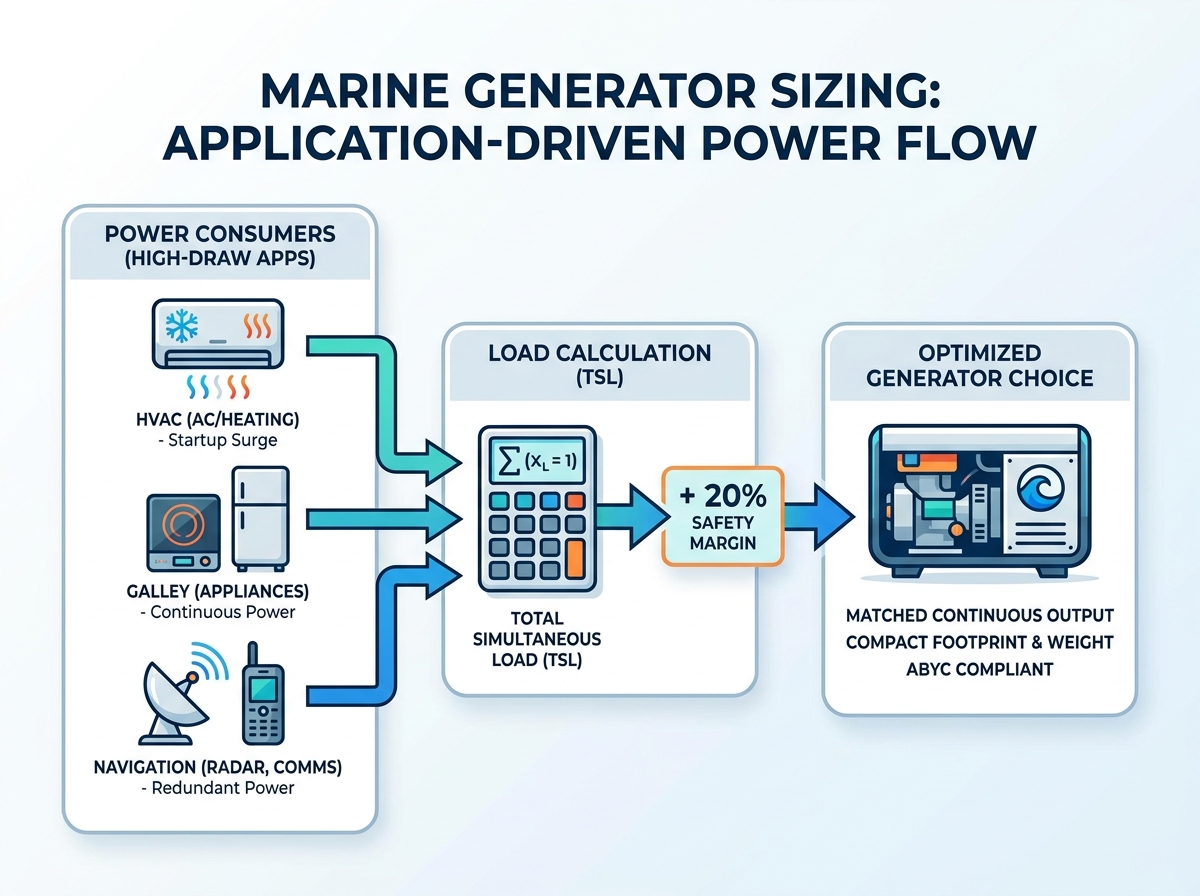
You must calculate your Total Simultaneous Load (TSL). Follow these specific steps to ensure accurate sizing:
List every electrical device you intend to run simultaneously.
Note the continuous running wattage for each item.
Identify the single highest startup surge (usually the AC compressor).
Add this peak surge to your total continuous running wattage.
Multiply the final number by 1.2 to add a 20% safety margin.
This exact formula prevents system overloads. It stops the common mistake of buying based solely on peak wattage marketing numbers. Continuous rating matters most.
Match your generator fuel directly to your primary propulsion system. Gasoline units pair nicely for outboard-powered center consoles. Diesel variants suit inboard cruisers much better. Single-fuel vessels offer easier logistical planning. You pull up to the fuel dock and fill one primary tank. Diesel fuel inherently offers lower volatility. It produces less carbon monoxide than gasoline. This makes diesel the preferred standard wherever budget and space allow.
Adding 150 to 300 pounds affects sub-35-foot boats dramatically. It changes how they draft in shallow water. It alters how quickly they achieve a plane. It shifts the center of gravity noticeably. You must position the heavy unit carefully. Placing it too far port or starboard induces a permanent list. Placing it too far aft causes the bow to ride excessively high. Consult your boat manufacturer about optimal placement zones.
Evaluate RPM ratings closely before buying. Many entry-level models run at 3000 or 3600 RPM. They use 2-pole electrical ends. Premium models run at 1500 or 1800 RPM using 4-pole ends. Lower RPM means significantly less vibration transmitted through the hull. It extends the internal equipment lifespan dramatically. A low-RPM unit hums quietly instead of screaming. This acoustic profile proves critical for sleeping comfortably in small cabins.
Marine environments forgive absolutely nothing. Regulatory compliance ensures your safety on the water. Never cut corners on installation protocols.
Marine electrical systems must feature strict ignition protection. The United States Coast Guard (USCG) mandates this safety standard by law. Enclosed boat bilges trap flammable gasoline vapors constantly. Standard alternators and starters create tiny sparks during operation. An unprotected spark causes catastrophic bilge explosions instantly. Compliant units seal their internal electrical components securely. They prevent internal sparks from igniting surrounding explosive fumes.
Terrestrial generators vent dangerous exhaust directly into ambient air. Marine-specific systems operate entirely differently. They use specialized water-cooled exhaust lines. The system mixes raw ocean water directly into hot exhaust gases via a water-lift muffler. This rapid cooling allows safe routing overboard near the waterline. You must also install marine-grade CO detectors inside every enclosed cabin space. Carbon monoxide pools silently in lower areas. It remains odorless and deadly.
Saltwater destroys standard electrical parts within months. Marine-grade units utilize completely tinned copper wiring. The tin coating stops green oxidation from traveling under the wire jacket. They feature galvanic isolators to prevent stray current corrosion at the marina. Closed-loop liquid cooling systems prevent internal engine blockages. They stop raw salt buildup from clogging narrow cooling passages. These features ensure your equipment survives harsh marine environments for decades.
Let's outline a concrete decision framework. Skip the guesswork entirely. Follow these sequential steps to find your exact match.
Measure your available lazarette or bilge space first. Do this long before looking at technical specifications. Build a simple cardboard mockup matching the dimensions of potential units. Place it in the bilge. Ensure you can still open the service doors fully. Check clearance for reaching the oil filter and raw water impeller. If you have zero dedicated space, pivot your strategy immediately. You must explore a pure-battery system instead.
Group your onboard applications logically. Separate the absolute "must-haves" from the "nice-to-haves". Must-haves include navigation, bilge pumps, battery chargers, and basic refrigeration. Nice-to-haves include air conditioning, water makers, and electric grills. Establish your minimum continuous wattage based only on the essential list. Only size up your unit if your vessel can handle the extra weight safely. You can also practice "load shedding." This means intentionally turning off the water heater while running the air conditioner. Load shedding allows you to install a smaller, lighter unit.
A dedicated power system represents a serious investment in vessel safety. It vastly improves your offshore capabilities. It is not merely a convenience upgrade for weekend comfort. It keeps your critical navigation and communication gear online during emergencies.
We advise buyers to prioritize ABYC-compliant, low-RPM units. Ensure they fit your exact continuous power load precisely. Oversizing wastes precious fuel and dead weight. Undersizing leads to dangerous electrical overloads and premature mechanical failure. Balancing these factors transforms a small boat into a highly capable offshore machine.
Take action before making a purchase. Consult a certified marine electrician locally. Have them audit your specific vessel wiring. Let them inspect your bilge layout and measure for exhaust routing. Proper planning guarantees a safe, reliable, and compliant installation.
A: We strongly discourage this practice. Portable terrestrial generators pose extreme carbon monoxide poisoning risks to the crew. They lack marine-specific grounding systems. They also lack mandatory ignition protection. Running them near enclosed gas-fume environments invites catastrophic explosions. Salt air destroys their unprotected internal components rapidly.
A: A 10,000 BTU marine air conditioner typically requires 2,500 to 3,500 starting watts (LRA). It needs about 1,000 running watts (RLA). To handle the startup surge safely while running other minor loads, we generally recommend installing a 3kW to 4kW unit.
A: Yes. Diesel fuel possesses much lower volatility than gasoline. It drastically reduces the risk of bilge explosions. Diesel engines also produce significantly less carbon monoxide exhaust. This makes diesel the preferred standard for marine environments whenever your budget and primary fuel source allow.