Newtec Power Equipment Co., Ltd.
English


Views: 0 Author: Site Editor Publish Time: 2026-10-28 Origin: Site
Selecting a marine power source represents a critical safety and operational investment. It involves a complex engineering choice entirely distinct from land-based power setups. A single oversight at sea can jeopardize both your vessel and your passengers.
Many buyers underestimate the risks of specification mismatches when outfitting their boats. Under-sizing a unit quickly leads to tripped breakers and premature component failure. Conversely, over-sizing a diesel unit often causes costly wet-stacking and irreversible engine degradation.
This guide provides an objective framework for evaluating marine power specifications. We cut through marketing claims to focus on regulatory compliance, precise sizing math, and integration realities. You will learn exactly how to match onboard electrical profiles to the right system.
Marine-Specific Standards: True marine generators require specialized ignition protection and corrosion resistance to meet USCG/ABYC compliance; land-based units cannot be safely substituted.
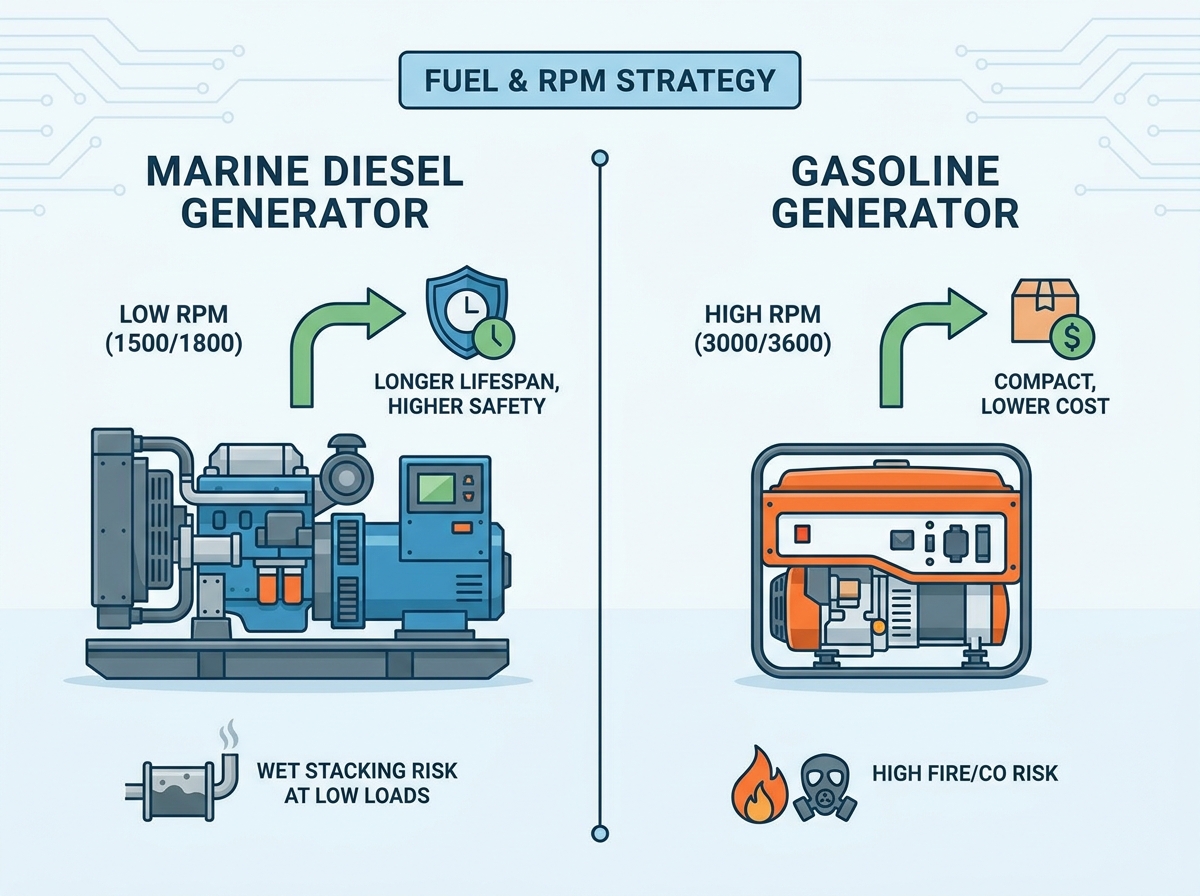
Fuel Strategy dictates Lifespan: Diesel dominates in reliability and safety (higher flash point), but requires careful load management to prevent carbon buildup.
RPM Defines Duty Cycle: 1500/1800 RPM generators offer quieter, continuous-duty lifespans, while 3000/3600 RPM models prioritize a compact footprint for tighter engine rooms.
Cooling & NVH are Critical: Closed-loop heat exchangers and heavy-duty sound enclosures separate premium units from budget options, directly impacting onboard comfort.
Buyers often ask why they pay a premium for marine units. The answer lies in the harsh environmental realities at sea. A boat presents strict safety and environmental challenges. You cannot substitute a cheaper land-based unit safely.
Regulatory compliance drives much of the required engineering. A genuine Marine Generator must meet USCG, ABYC, and European CE standards. The foremost requirement involves spark and ignition protection. Bilge areas often accumulate volatile fuel vapors. Certified marine units seal internal electrical components securely. This prevents arcing and subsequent bilge explosions.
Material construction also differs drastically from standard units. Saltwater aerosol degrades normal metals rapidly. Marine-grade units utilize specialized alloys and heavy-duty epoxy coatings. Manufacturers use tinned wiring throughout the entire electrical harness. This barrier prevents moisture from wicking into the copper strands. It effectively stops hidden electrical shorts.
Emission tiers present another vital compliance layer. You must evaluate EPA Tier 3 or Tier 4 standards depending on your operating region. Larger vessels may fall under strict IMO Tier III regulations. Compliance ensures legal operation across protected international waters.
Evaluating your primary power source depends heavily on your main engines. Your vessel's overall safety profile also dictates this choice. You generally choose between diesel and gasoline architectures.
Feature | Marine Diesel Generators | Gasoline (Petrol) Generators |
|---|---|---|
Safety Profile | High (Low fuel volatility) | Low (High explosion hazard) |
Initial Cost | Higher | Lower |
Size & Weight | Heavier, larger footprint | Compact, lightweight |
Primary Risk | Wet-stacking under low loads | Carbon monoxide emissions |
Marine Diesel Generators serve as the undisputed industry standard. They offer superior safety due to a much lower volatility point. Diesel fuel rarely ignites at room temperature. They deliver excellent fuel efficiency and substantially longer engine life. You can also plumb them directly into your main propulsion fuel tank. This integration simplifies onboard fluid management significantly.
However, diesel carries specific operational risks. You face a higher upfront cost and a heavier structural footprint. Diesel engines also risk "wet stacking." This occurs when you run them consistently below 60% load. Unburned fuel forms heavy carbon deposits. This buildup degrades the exhaust system and lowers efficiency.
Gasoline generators offer a different value proposition. They present a lower initial purchase cost. They feature compact sizing ideal for smaller vessels like center consoles or small cruisers.
Yet, gasoline systems carry substantial safety risks. Gasoline vapors pose a high fire and explosion hazard inside enclosed spaces. They require strict, active ventilation protocols. They also emit dangerous carbon monoxide (CO) levels. You must carefully monitor these emissions to protect passengers asleep below deck.
Moving beyond raw peak power reveals operational reality. You must size your unit accurately to ensure long-term reliability.
Sizing calculations require understanding both kW and kVA ratings. You must calculate your total continuous load accurately. This includes steady electrical draws from:
Onboard HVAC units and chillers
Gyroscopic stabilization systems
Watermakers and desalination pumps
Refrigeration and galley appliances
Next, you must factor in peak starting loads. Electric motors create massive power surges upon initial startup. We highly recommend sizing your Marine Generator carefully. Your normal cruising load should hit 70% to 80% of its rated capacity. This best practice ensures optimal efficiency and prevents harmful carbon buildup.
The RPM divide separates units by their intended duty cycles. Buyers must choose between two distinct alternator designs.
Low RPM models operate at 1500 or 1800 RPM. They feature 4-pole alternators. They are heavier and much larger. However, they are designed specifically for continuous, quiet operation. They offer extended service intervals. You will find them ideal for large yachts and commercial vessels requiring uninterrupted power.
High RPM models operate at 3000 or 3600 RPM. They utilize 2-pole alternators. They remain smaller and much lighter. Inherently, they run louder and experience faster internal wear. They suit intermittent use on smaller recreational boats perfectly.
How a unit manages heat impacts passenger comfort directly. You must evaluate cooling system architectures carefully before buying.
Raw water cooling offers a mechanically simpler design. It pumps seawater directly through the engine block. However, this exposes internal engine jackets directly to corrosive saltwater. Internal scaling and rust will eventually compromise the engine block entirely.
Closed-loop cooling circulates fresh coolant through the engine itself. It relies on a heat exchanger. The heat exchanger transfers internal engine heat to the raw water safely. The raw water never touches the internal engine block. This architecture remains the absolute standard for longevity in saltwater environments. Any premium power system will utilize a closed-loop design.
NVH (Noise, Vibration, and Harshness) mitigation requires equal attention. You should evaluate the quality of available sound shields. Check the decibel ratings measured at 1 meter or 7 meters. Heavy-duty enclosures separate premium models from budget options.
Furthermore, multi-point vibration isolation mounts are crucial. They prevent engine vibrations from transferring directly into the hull. Hull resonance can ruin the onboard experience during long overnight passages.
What happens after you sign the purchase order? Implementation risks often surprise new buyers during the installation phase.
Footprint and service accessibility remain paramount. A compact unit becomes useless if technicians cannot reach critical components. You must access the raw water impeller easily. The oil filter and fuel pump require regular servicing. Ensure all primary maintenance points offer single-side accessibility inside tight engine rooms.
Integration challenges require expert planning. Exhaust routing demands careful engineering. Water-lift mufflers help quiet the aggressive exhaust note. Gas/water separators allow for near-silent discharge right at the waterline.
Ventilation needs are critical to prevent sudden overheating. Enclosed engine compartments trap massive amounts of radiant heat. Adequate airflow ensures the alternator and internal sensors do not overheat under heavy loads.
Electrical integration involves complex onboard wiring. You may need specific synchronization panels if you run dual units. Proper electrical integration prevents accidentally back-feeding power into shore power connections.
Follow this step-by-step decision framework to finalize your upcoming purchase safely.
Audit your vessel’s actual electrical load. Measure your available engine room footprint accurately.
Match the unit's fuel type to your primary propulsion system. This simplifies plumbing, safety protocols, and fuel storage.
Filter available models by your continuous-duty requirements. Choose your RPM rating based on expected runtime. Consider your passenger NVH tolerances carefully.
Verify local parts availability for your chosen brand. Ensure certified service networks operate within your primary cruising grounds.
Buying a reliable marine power source requires matching exact electrical profiles. You must also navigate strict spatial constraints. Do not simply buy the highest kW rating available. Oversizing creates as many operational problems as undersizing.
Paying for the right cooling system and proper RPM rating yields high long-term value. Exact sizing reduces maintenance intervals significantly. It prevents catastrophic failures during long offshore passages and extends engine life.
We encourage you to consult a certified marine electrical engineer. Request a custom load-analysis quote before making your final decision. Proper planning ensures safe, reliable power across all your maritime adventures.
A: Oversized units rarely reach their optimal operating temperature. This causes "wet stacking." Unburned fuel and soot build up as carbon deposits inside the exhaust system. You will notice dark, smoked exhaust and rough running. Over time, this buildup causes severe engine damage and glazed cylinder walls. Always size the unit so your normal load requires 70% to 80% of its total capacity.
A: No. We strictly advise against using portable land-based units on vessels. They lack critical marine ignition protection. Running them in enclosed spaces creates extreme fire and explosion hazards. They also emit dangerous carbon monoxide (CO) directly onto the deck. Furthermore, land-based alternators corrode rapidly when exposed to harsh saltwater environments.
A: Lifespans vary heavily by fuel type and operating speed. A well-maintained 1800 RPM diesel unit can easily exceed 10,000 hours of continuous service. Conversely, high-speed 3600 RPM gasoline models wear out much faster. They typically require replacement or major overhauls between 3,000 and 5,000 hours. Strict adherence to oil and impeller service intervals extends these benchmarks significantly.
A: A gas/water separator is an advanced exhaust component. It splits exhaust gases from the injected cooling water before they exit the hull. The water drains silently below the waterline. The dry exhaust gas vents quietly above the surface. This eliminates the loud splashing noise typical of standard marine exhausts. It is crucial for maintaining peaceful anchorages.